
Taiwan Team’s Breathing-Mimicking Stem Cell Platform Reduces Pulmonary Fibrosis in Preclinical Study
TAICHUNG, Nov. 17, 2026
Press Release Disclaimer: This is a press release distributed through the XPR Media network. It has not been independently verified by our newsroom.

Taiwan Team’s Breathing-Mimicking Stem Cell Platform Reduces Pulmonary Fibrosis in Preclinical Study
PR Newswire
TAICHUNG, Nov. 17, 2026
China Medical University Hospital study in Biomaterials shows extracellular vesicles from “breathing-trained” stem cells carry about 3.3 times more antifibrotic miR-30
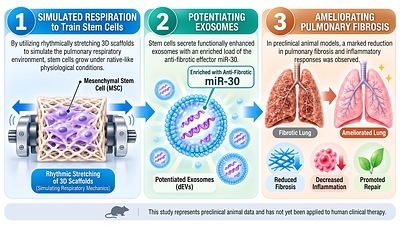
TAICHUNG, Nov. 17, 2026 /PRNewswire/ — Researchers at China Medical University Hospital (CMUH) in Taiwan have developed a biomimetic dynamic culture platform that mimics the rhythmic stretching of the lungs during breathing. Stem cells grown on the platform released extracellular vesicles (EVs), small particles that carry molecular signals between cells, containing about 3.3 times as much of an antifibrotic microRNA. In a rat model of pulmonary fibrosis, the EVs reduced lung scarring and markers of inflammation. The study was published in Biomaterials, a peer-reviewed journal published by Elsevier.
Pulmonary fibrosis scars and stiffens lung tissue, which can cause a persistent dry cough and shortness of breath. Antifibrotic drugs can slow the progression of idiopathic pulmonary fibrosis, one form of the disease. Finding ways to reduce established scarring and promote tissue repair remains a research challenge.
“Current treatments for pulmonary fibrosis mainly slow the disease, and they rarely restore tissue that has already scarred,” said Dr. Der-Yang Cho, superintendent of CMUH, who led the research. “By bringing the lung’s natural motion into stem cell culture, we are exploring a new way to produce EVs with greater repair potential.”
The research team also included Dr. Hsin-Yuan Fang, vice superintendent for surgery; Dr. Jian-Xun Chen, a thoracic surgeon; and Dr. Ming-You Shie, deputy director of the hospital’s Xenotransplantation Translational Research Center.
Mimicking the motion of breathing
Fang said the team took its cue from the way lung tissue expands and recoils with each breath, whereas stem cells are conventionally grown under static conditions. The researchers grew mesenchymal stem cells on a three-dimensional scaffold containing a lung-derived matrix. They stretched the scaffold rhythmically to mimic breathing, then compared the EVs released by those cells with EVs from cells grown under static conditions.
EVs from the dynamic culture contained about 3.3 times as much microRNA-30 (miR-30) as those from the static culture. The finding showed that changing the physical conditions in which stem cells grow can alter the molecular cargo of the EVs they release.
How miR-30 affects scarring and inflammation
Chen said the rhythmic stretching activated a signaling protein called YAP, which helps cells respond to mechanical forces. This signal led the stem cells to package more miR-30 into the EVs.
The researchers found that miR-30 delivered by the EVs limited the activation of myofibroblasts, cells that contribute to scarring by depositing collagen. It also shifted macrophages, a type of immune cell, from a pro-inflammatory state toward a tissue-repairing state. In injured cells, the EVs helped restore mitochondrial function.
Results in a rat model
The team evaluated the EVs in laboratory experiments with human lung fibroblasts and in rats with experimentally induced pulmonary fibrosis. After intranasal administration of the EVs in rats, the researchers observed less collagen buildup, lower levels of inflammatory markers and improved lung tissue structure. EVs produced on the breathing-mimicking platform showed stronger antifibrotic effects than those from static cultures.
“These are preclinical findings, and more work is needed before the approach can be tested in patients,” Cho said. “Our team will continue to evaluate safety and efficacy as we work toward clinical translation.”
Read the study, “[Dynamic tensile conditioning of mesenchymal stem cell-laden auxetic scaffolds for enhanced YAP-dependent miR-30 enrichment in extracellular vesicles for pulmonary fibrosis therapy],” in Biomaterials: https://doi.org/10.1016/j.biomaterials.2026.124705
About China Medical University Hospital
Founded in 1980 and based in Taichung, Taiwan, China Medical University Hospital (CMUH) has seven medical buildings, 2,202 beds and 6,418 employees. Each month, the hospital handles about 219,000 outpatient visits, 13,000 emergency visits, 7,300 inpatient admissions and 5,900 surgeries, making it a trusted medical center for the communities it serves. In addition to patient care, CMUH trains health professionals and conducts biomedical research. For more information, visit https://www.cmuh.cmu.edu.tw.
 View original content to download multimedia:https://www.prnewswire.com/news-releases/taiwan-teams-breathing-mimicking-stem-cell-platform-reduces-pulmonary-fibrosis-in-preclinical-study-302942223.html
SOURCE China Medical University Hospital


