
Lyro Report: AI Shopping Assistants Are Becoming a Real Commerce Interface
New report examines the evidence behind AI shopping assistant results at Amazon, Walmart, Magalu and Salesforce—and
Press Release Disclaimer: This is a press release distributed through the XPR Media network. It has not been independently verified by our newsroom.

New report examines the evidence behind AI shopping assistant results at Amazon, Walmart, Magalu and Salesforce—and shows retailers how to test their own.
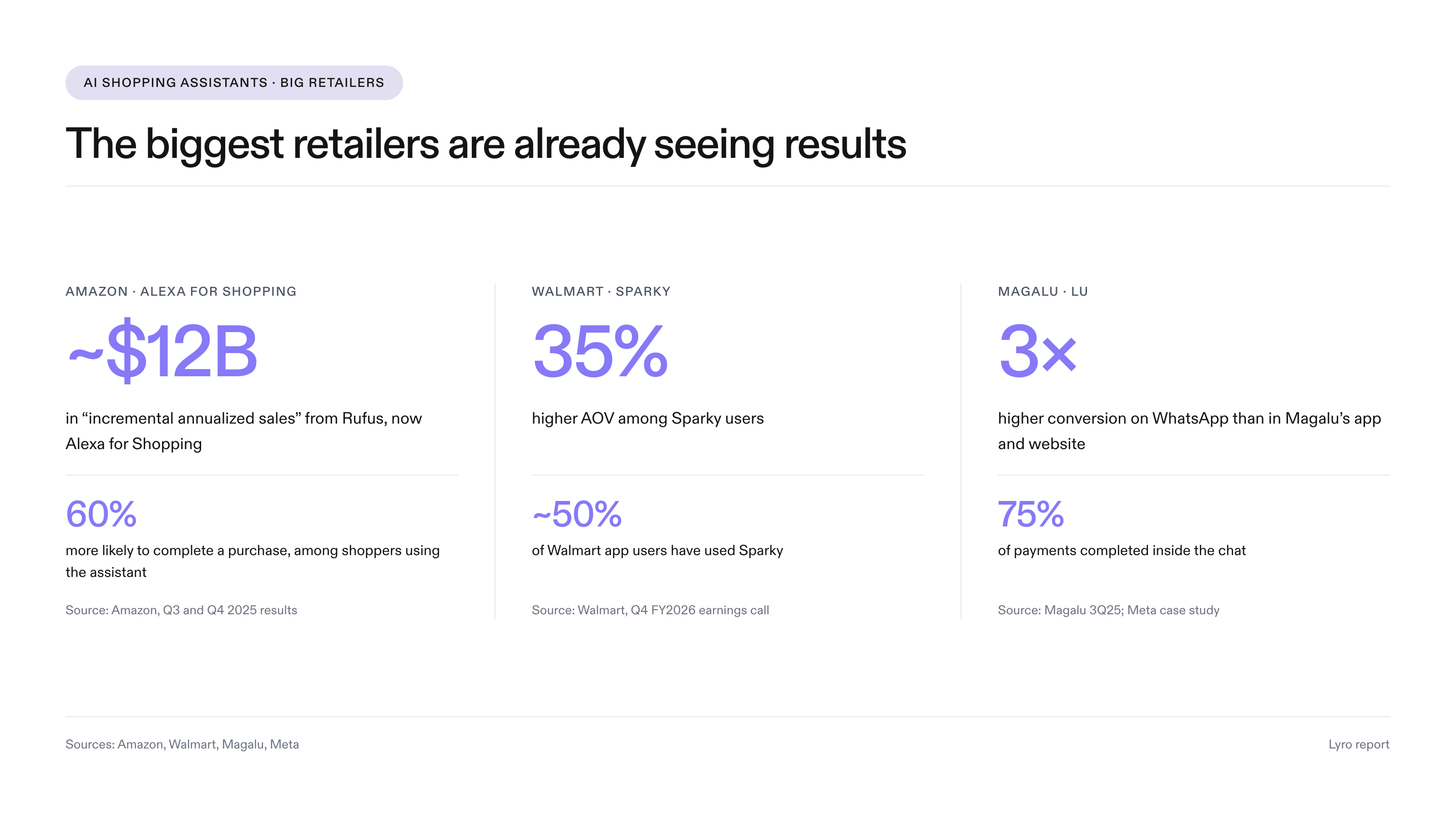
SAN FRANCISCO, CA, UNITED STATES, September 28, 2026 /EINPresswire.com/ — Amazon says its AI shopping assistant helped deliver nearly $12 billion in what it calls incremental annualized sales in 2025. Walmart says shoppers who use its assistant, Sparky, carry an average order value about 35% higher than those who do not. Salesforce estimates that AI and agents influenced $262 billion in 2025 global online holiday sales.
The numbers are large. But they do not measure the same thing.
That distinction is at the center of AI Shopping Assistants for E-Commerce, a new Lyro report by Bart Turczynski, Head of Growth at Tidio.
The report draws on 39 published sources, including retailer earnings disclosures, market data, industry research, and randomized experiments. Its central question is not whether AI-assisted shopping is associated with commercial activity. It is whether AI assistants create incremental value that would not have existed without them.
Amazon provides the largest disclosed example. The company said more than 300 million customers used its shopping assistant in 2025 and that it helped deliver nearly $12 billion in incremental annualized sales. Amazon separately reported that shoppers using the assistant were 60% more likely to complete a purchase. But those are different kinds of evidence: Amazon describes the first figure as incremental, while the second is an observed association between assistant use and purchase behavior. The company’s public earnings release does not describe the experimental design behind the $12 billion estimate.
That difference matters because assistant-attributed revenue is not necessarily new revenue.
“If the assistant gets credit for an order that the shopper would have completed through search five minutes later, attributed AI revenue has increased while retailer revenue has not,” the report says.
A real A/B test published by Etsy illustrates the problem. A recommendation change increased recommendation clicks by 28.3%, but conversion rose by a statistically insignificant 0.22% and GMV fell by a statistically insignificant 0.25%. At the same time, clicks on organic search results fell significantly by 1.4%.
Etsy’s causal mediation analysis found that the recommendation change itself increased conversion by 0.50%, while the resulting decline in search activity reduced conversion by 0.28%. In other words, roughly half of the genuine conversion gain was consumed by displaced search activity.
The report argues that AI shopping assistants should therefore be judged on incremental commercial contribution, not engagement or attributed sales alone.
That does not mean the existing retailer results are unimportant. The report concludes that AI shopping assistance is becoming a real commerce interface rather than a customer-service novelty. Walmart’s higher average order value among Sparky users and Magalu’s report of conversion three times higher in its WhatsApp shopping experience than in its app are both commercially meaningful. But they are observational comparisons, between user groups at Walmart and between channels at Magalu, rather than randomized estimates of causal lift. Salesforce’s $262 billion is likewise an attribution estimate of sales influenced by AI and agents, drawn from data on more than 1.5 billion shoppers.
“The retailers in this report—Amazon, Walmart, Home Depot, Magalu—are deploying these systems at scale and already reporting results that reach the P&L,” wrote Tytus Gołas, Founder and CEO of Tidio, in the report’s foreword. “They have the engineering budgets to match. Most retailers do not.”
For smaller retailers, the first measurable value may appear somewhere else.
UK mattress retailer MattressNextDay, a Tidio customer, reports that its assistant resolves 73% of customer conversations without a human, returning more than 400 hours per month to its support team. UK flooring retailer Renovate Direct, also a Tidio customer, reports that its resolution rate increased to 69% from 42% after the assistant began routing tickets by intent. The report labels both as operator-reported results rather than controlled experiments.
The report also argues that proactive AI assistance makes incrementality easier to test. Because a retailer controls whether a proactive prompt is shown, it can expose one comparable group of shoppers to the intervention while withholding it from another. That creates a practical holdout test without requiring the retailer to replace search, navigation, or its existing recommendation systems.
The report proposes evaluating such pilots using eligible sessions, exposure rate, incremental order-rate change, and average order value, before accounting for margin, returns, and operating costs. Once a retailer has a real holdout result, the report identifies incremental contribution per eligible session as one of the most useful summary metrics.
“The correct forecast comes from the retailer’s own experiment,” the report says.
The question for retailers is no longer whether AI shopping assistants can matter, but where they create measurable incremental value.
The full report is available at https://www.getlyro.ai/reports/ai-shopping-assistants
For media inquiries, visit https://tid.io/newsroom
About Tidio
Tidio is an AI-powered customer service platform that helps businesses manage and automate customer conversations. Its Lyro AI Agent resolves customer inquiries automatically and escalates more complex cases to human operators. https://www.tidio.com
About Lyro
Lyro is Tidio’s AI agent for customer service, designed for e-commerce, SaaS, and service businesses. Across Tidio’s client base, Lyro averages a 72% resolution rate, automating routine customer conversations while allowing human teams to focus on more complex cases. https://www.getlyro.ai
Roberta Raczyńska
Tidio
pr@pr-tidio.net
Visit us on social media:
LinkedIn
Instagram
Facebook
YouTube
TikTok
X
Other
Meet Lyro, Tidio’s AI agent for customer service
Legal Disclaimer:
EIN Presswire provides this news content “as is” without warranty of any kind. We do not accept any responsibility or liability
for the accuracy, content, images, videos, licenses, completeness, legality, or reliability of the information contained in this
article. If you have any complaints or copyright issues related to this article, kindly contact the author above.

Media gallery


