New Academic Book Argues Nathaniel Hawthorne Portrayed Rumored Edgar Poe – Frances Osgood Affair in The Scarlet Letter
Attorney Andrew Barger’s book: The Affair of Edgar Poe and Frances Osgood in The Scarlet Letter deconstructs
Press Release Disclaimer: This is a press release distributed through the XPR Media network. It has not been independently verified by our newsroom.
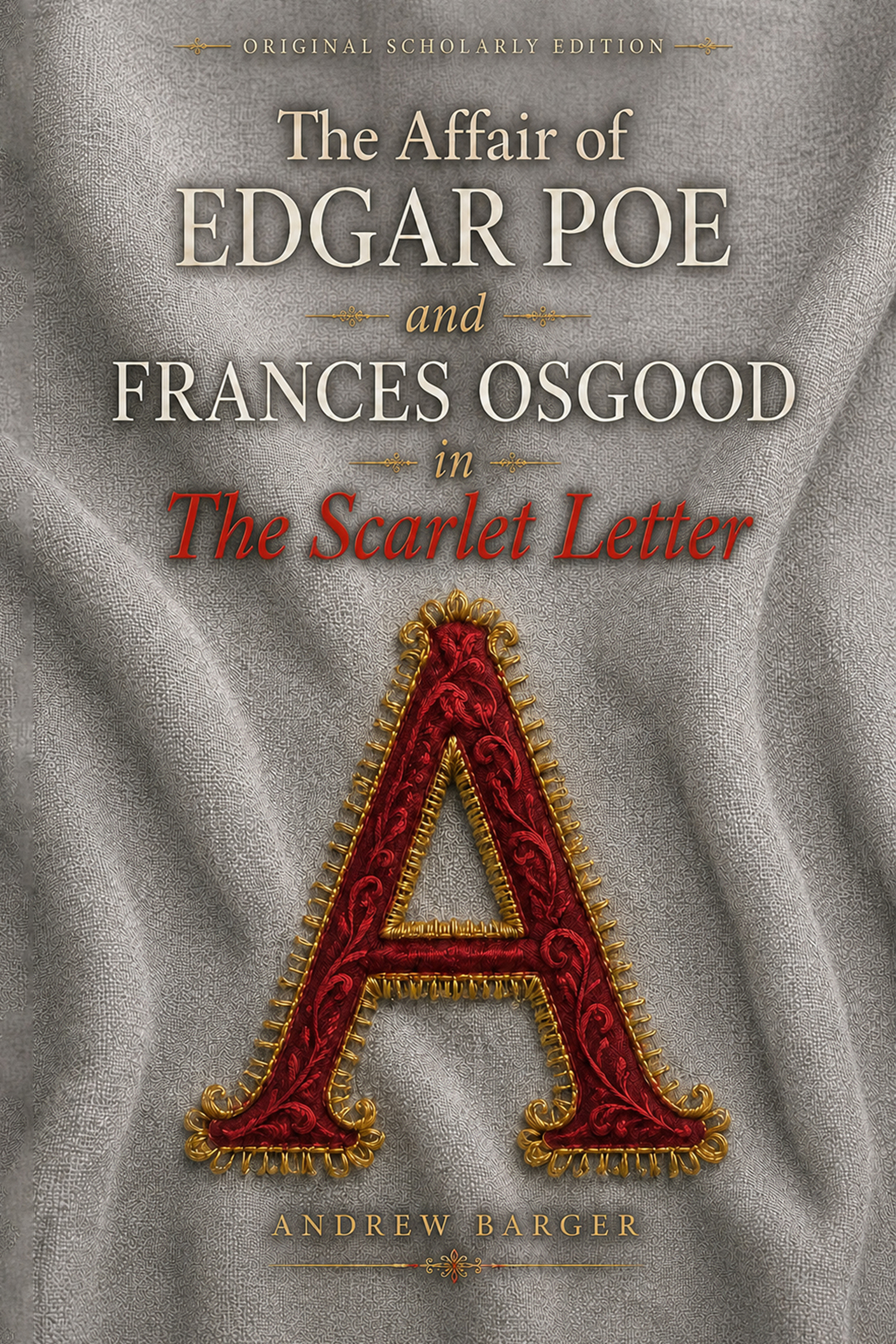

Attorney Andrew Barger’s book: The Affair of Edgar Poe and Frances Osgood in The Scarlet Letter deconstructs Hawthorne’s most beloved novel over 500 footnotes.
SARASOTA, FL, UNITED STATES, September 29, 2026 /EINPresswire.com/ — For 175+ years, classrooms have taught Nathaniel Hawthorne’s The Scarlet Letter as a Puritan moral allegory of sin, secrecy, and public shame. A new academic book contends that the novel also carries a second, tightly coded plot: a roman à clef of the rumored mid-1840s affair between Edgar Allan Poe and the popular poet Frances Sargent Osgood.
The Affair of Edgar Poe and Frances Osgood in The Scarlet Letter
Author: Andrew Barger
Publisher: Bottletree Books, LLC
Publication date: June 26, 2026
ISBN: 978-1-933747-78-1
Length: 242 pages
Formats: Hardcover, Paperback, Audiobook, and Ebook
The Affair of Edgar Poe and Frances Osgood in The Scarlet Letter, presents a watershed scholarly argument that Hawthorne recast the aftermath of the Poe-Osgood scandal in a Puritan setting.
Attorney and Poe scholar Andrew Barger, a member of the Nathaniel Hawthorne Society, the Edgar Allan Poe Society, and the Poe Society of Baltimore, compares names, appearances, temperament, craft, and biography among Hawthorne’s characters and the Northeast writers of the day. Barger include photos of the authors presented.
Barger’s identifications, developed across a detailed table of contents and more than five hundred footnotes, include:
*Frances Sargent Osgood as Hester Prynne — a beauty whose art sells, who keeps a vow of silence about the child’s father, and whose surname, Barger argues, is a transition cipher of Osgood, in a nod to Poe’s well-known passion for cryptography;
*Edgar Allan Poe as the Rev. Arthur Dimmesdale — the pale, dark-eyed, dark-clad scholar with a broad forehead, a sensitive temperament, public eloquence, who places hand over his heart;
*Fanny Fay Osgood, Osgood’s third child, as Pearl — the “fairy” child (Fay is an older word for fairy) whose life, like Pearl’s, mixes welcome and blame; Barger submits that Mary Seward called the child “Pearl” in a memorial poem after Osgood’s death;
*Rufus Wilmot Griswold as Roger Chillingworth — the grizzled, vindictive man of letters with the power to destroy a career, and the author of the notorious “Ludwig” obituary that, Barger contends, Hawthorne drew upon for Dimmesdale’s worst traits;
*Elizabeth Fries Ellet as the witch, Mistress Hibbins;
*Nathaniel Parker Willis as John Wilson; and
*Thomas Dunn English as Governor Bellingham — with further correspondence for James Fenimore Cooper.
The study demonstrates that Hawthorne embedded secret ciphers in the novel and a code in its famously cryptic ending. Poe, not so subtly, hinted that Hawthorne plagiarized from him and that he should not write allegory. Barger’s “Hawthorne’s Fivefold Motivation” chapter yields five main reasons Hawthorne sought revenge: (1) Poe’s harsh published criticism of Hawthorne, (2) Poe’s Longfellow War, (3) Transcendentalist controversies around The Dial and Brook Farm, (4) Poe’s lampooning of Margaret Fuller, and (5) Poe’s perceived lack of morals.
Why this allegorical layer went unseen
Barger posits that two scholarly silences made the pattern easy to miss. Hawthorne specialists, he writes, have rarely possessed a detailed map of the Poe–Osgood rumor. Poe specialists, meanwhile, have often declined a full accounting of the attachment—partly from what Barger wryly calls the “Hasn’t Poe Suffered Enough” doctrine, and partly because no one has systematically read Osgood’s poems with a view towards Poe, many published under pseudonyms.
He distinguishes his project from John Evangelist Walsh’s 1980 narrative history Plumes in the Dust, which asserted an illicit affair and the paternity of Fanny Fay but, Barger and earlier critics agree, examined too little of Osgood’s post-1845 writing and missed Hawthorne entirely.
The volume is designed for teachers, professors, and advanced students as much as for specialists. It includes daguerreotypes and illustrations, a foreword, a systematic character-by-character comparison, a conclusion and afterword, and an appendix of names.A companion teaching text, The Scarlet Letter: Edgar Poe and Frances Osgood Edition and Study Guide, reprints Hawthorne’s novel with chapter-by-chapter analysis and discussion questions keyed to the same thesis.
Andrew Barger’s website is www.andrewbarger.com; he writes on Substack at DangerousLore.Substack.com and on X as @DangerousLore.
MEDIA: Review copies, podcast bookings, and author interviews are available on request.
Andrew Barger
Bottletree Books LLC
email us here
Visit us on social media:
Other
X
YouTube
LinkedIn
Book Trailer: The Affair of Edgar Poe and Frances Osgood in The Scarlet Letter
Legal Disclaimer:
EIN Presswire provides this news content “as is” without warranty of any kind. We do not accept any responsibility or liability
for the accuracy, content, images, videos, licenses, completeness, legality, or reliability of the information contained in this
article. If you have any complaints or copyright issues related to this article, kindly contact the author above.

Media gallery